Playing Catch With Newton: a Beginner’s Guide to Tesseracts
This post originally appeared on Pasteur Labs Insights.
Introduction
This tutorial introduces the Tesseract ecosystem through a physics-based example. We’ll build a Tesseract from scratch that containerizes a computational tool and implements derivative endpoints for use in differentiable pipelines.
This beginner’s guide will teach you how to write a custom Tesseract to distribute a computational tool. We assume basic differential calculus knowledge and Python familiarity (including NumPy-style array operations). No prior Tesseract ecosystem experience is required.
The physics: Projectile motion
Researchers regularly use fantastic software tools — physics simulators, machine learning models, meshers, and more. But these tools often present installation and configuration barriers for new users. With Tesseracts, you can wrap any tool so it’s installable locally via a single command or accessible remotely, all sharing a uniform JSON interface.
To see how this works, let’s start with a simple physics example: projectile motion.
Newton’s challenge
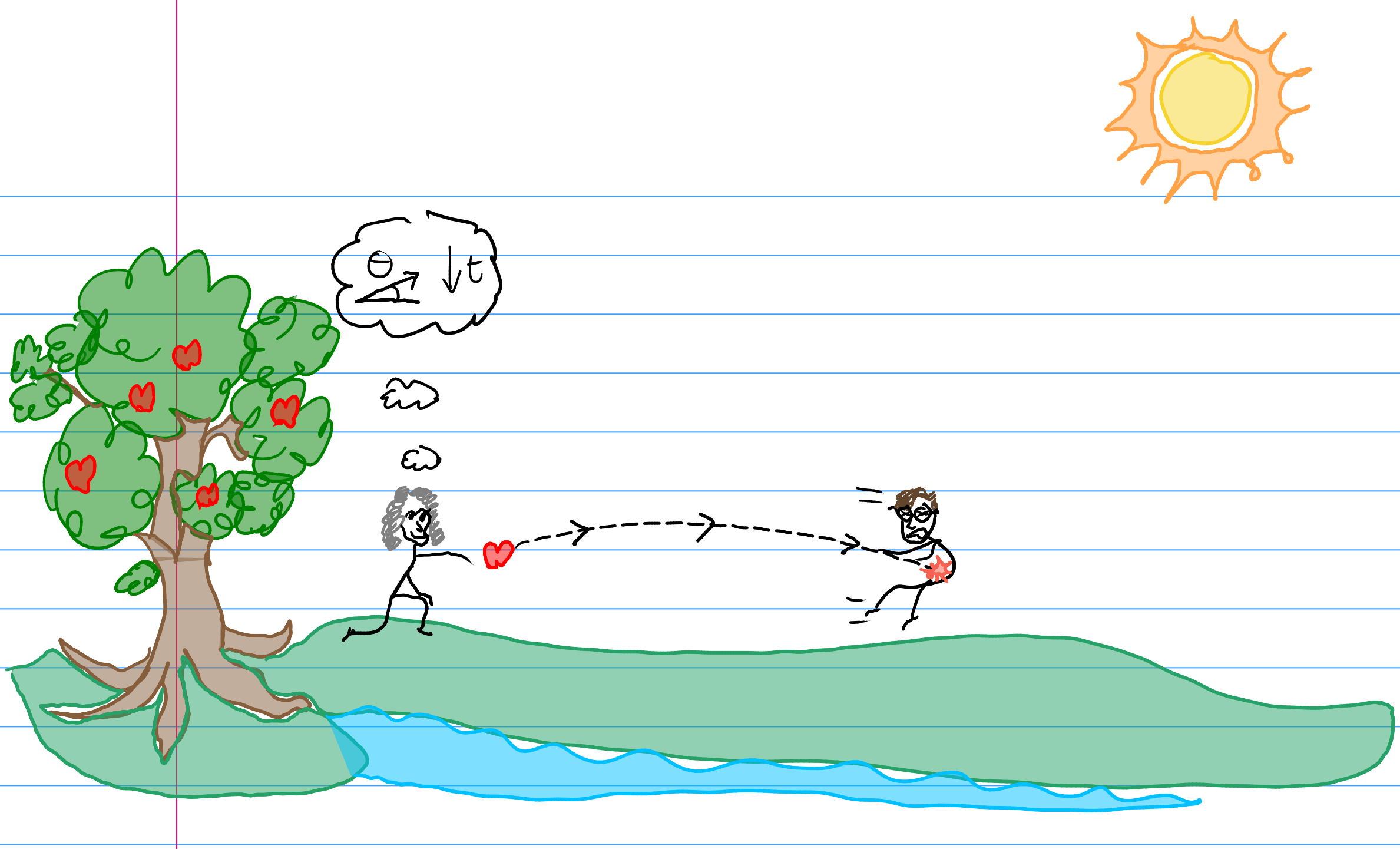
Imagine you’re playing catch with Isaac Newton. He throws a ball from a fixed distance away, and it arrives after a certain flight time. Newton points out that given a fixed distance and flight time, “only one path” exists — a unique combination of speed and angle.
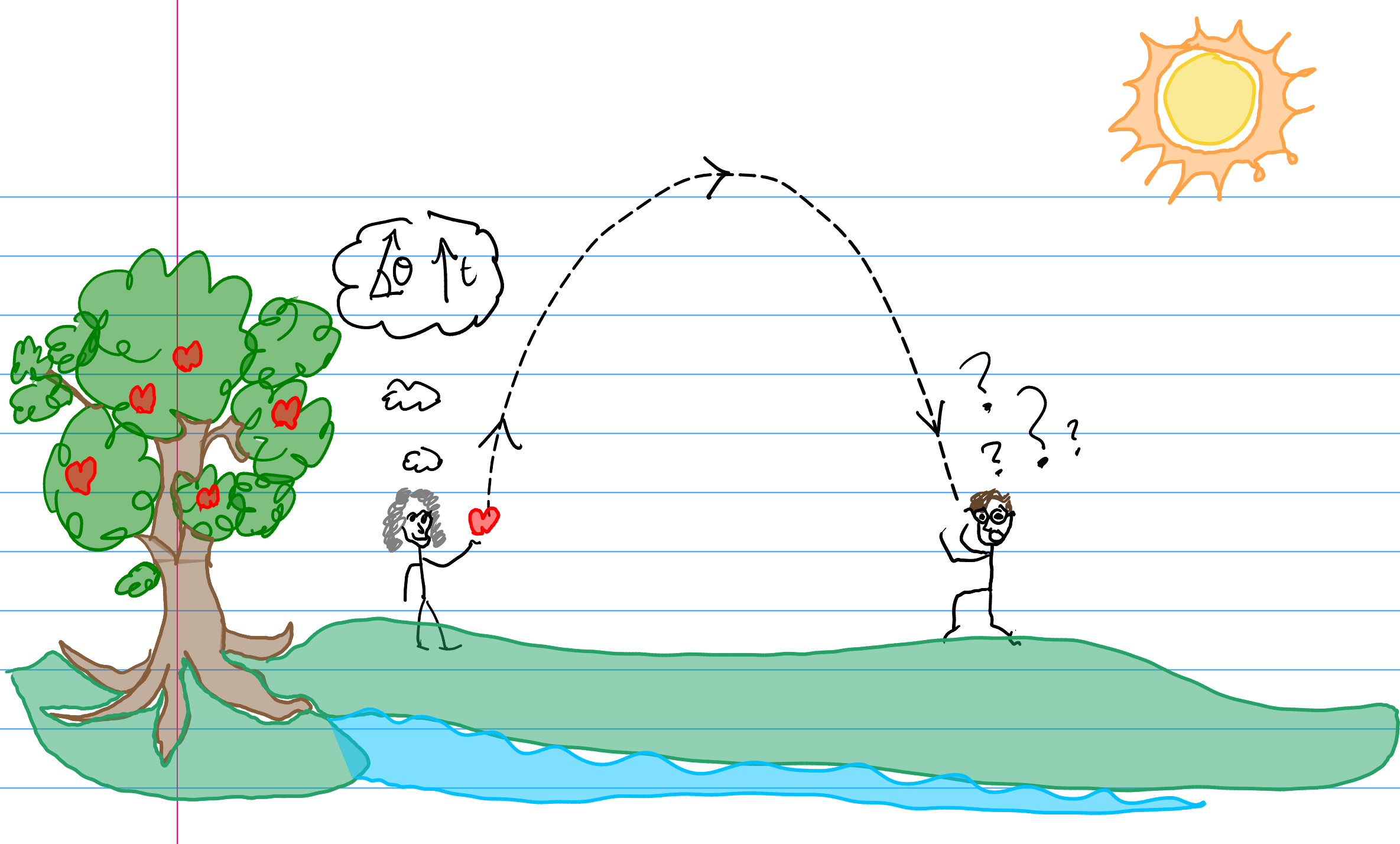
The equations
Under constant gravitational acceleration, we can describe the projectile’s motion with two key equations.
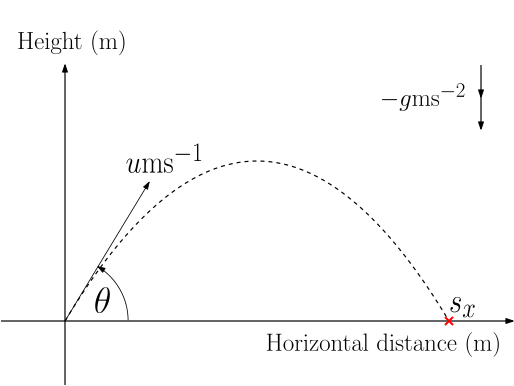
Time of flight:
Horizontal distance:
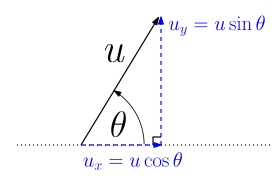
Where \(u\) is the initial velocity, \(\theta\) is the launch angle, and \(g = 9.81 \, \text{m/s}^2\) is the gravitational acceleration.
These equations establish a one-to-one correspondence between input coordinates \((u, \theta)\) and output coordinates \((s_x, t)\).
Building the Tesseract
Project structure
Initialize a new Tesseract project:
$ tesseract init
This generates three files: tesseract_api.py, tesseract_config.yaml, and tesseract_requirements.txt.
Configuration
Name the Tesseract “projectile” and describe its purpose:
name: "projectile"
version: "0.0.1"
description: |
  Given a projectile with an initial speed and angle, computes the
  horizontal distance and time-of-flight for it to return to zero
  vertical displacement.
Add JAX as a dependency in tesseract_requirements.txt:
jax[cuda]==0.5.3
Schema definition
Define the input and output schemas using Pydantic models with Differentiable type annotations:
from pydantic import BaseModel
from tesseract_core.runtime import Differentiable, Float32

class InputSchema(BaseModel):
    speed: Differentiable[Float32]
    angle: Differentiable[Float32]

class OutputSchema(BaseModel):
    distance: Differentiable[Float32]
    time: Differentiable[Float32]
Physics functions
Implement the core physics using JAX for automatic differentiation support:
import jax.numpy as jnp

RECIP_GRAV_STRENGTH = 1.0 / 9.81

OUTPUT_FUNCS = {
    "distance": lambda speed, angle: (
        speed * speed * RECIP_GRAV_STRENGTH * jnp.sin(2.0 * angle)
    ),
    "time": lambda speed, angle: (
        2.0 * speed * RECIP_GRAV_STRENGTH * jnp.sin(angle)
    ),
}
Automatic differentiation
Using jax.grad(), we can automatically compute the Jacobian matrix:
GRAD_FUNCS = {
    output_name: {
        input_name: jax.grad(func, argnums=num)
        for num, input_name in enumerate(arg_names(func))
    }
    for output_name, func in OUTPUT_FUNCS.items()
}
Endpoints
The apply endpoint computes forward evaluation:
def apply(inputs: InputSchema) -> OutputSchema:
    return OutputSchema(
        distance=OUTPUT_FUNCS["distance"](
            speed=inputs.speed, angle=inputs.angle
        ),
        time=OUTPUT_FUNCS["time"](speed=inputs.speed, angle=inputs.angle),
    )
The jacobian endpoint computes derivatives:
def jacobian(
    inputs: InputSchema,
    jac_inputs: set[str],
    jac_outputs: set[str],
) -> dict[str, dict[str, float]]:
    grads = defaultdict(dict)
    for output_name, input_name in product(jac_outputs, jac_inputs):
        grads[output_name][input_name] = GRAD_FUNCS[output_name][input_name](
            inputs.speed, inputs.angle
        ).item()
    return dict(grads)
Testing it out
Build the Tesseract:
$ tesseract build .
Test with the CLI:
$ tesseract run projectile apply '{"inputs": {"speed": 10.0, "angle": 0.75}}' | jq .
Verify the Jacobian computation at \(u = 10\), \(\theta = 0.75\) rad — the numerical results should match the analytical derivatives.
What’s next
By wrapping even a simple physics model in a Tesseract, we get a containerized, self-documenting component with a standard JSON interface and built-in derivative support. Now you’re ready to explore gradient-based optimization via Tesseract-JAX and interactive visualization via Tesseract-Streamlit for these differentiable components.

Tesseract is a free, open-source framework for differentiable scientific computing. pip install tesseract-core.
Docs · Demos · GitHub · Forum